Before You Sign That Lease: The Real Answers to 10 Questions Every Relocator Asks About Austin
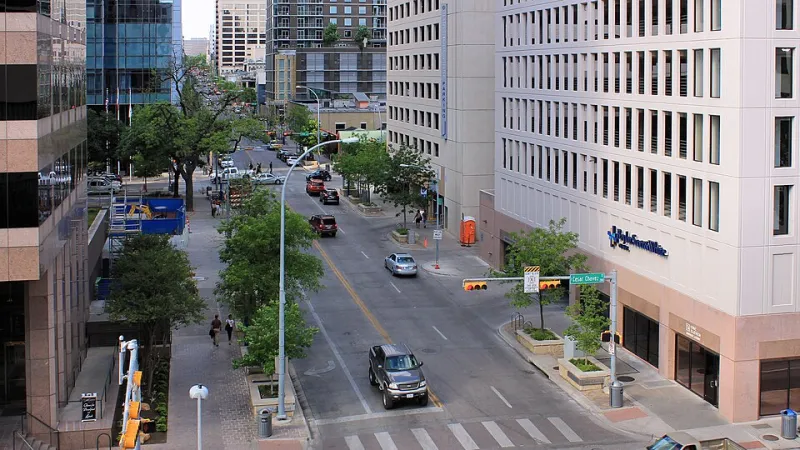
Photo: Larry D. Moore, CC BY 4.0, via Wikimedia Commons
Every week, we get emails from people in California, Illinois, New York, and Florida asking some version of the same thing: "Okay, but what's the catch?"
Fair question. Austin's been marketed to death — the music, the tacos, the jobs — and almost nobody talks about the fine print. So here it is, the honest version. Ten questions, ten straight answers.
1. "Is Austin actually cheaper than where I'm coming from?"
Probably, but less than it used to be. If you're leaving the Bay Area or Manhattan, yes — you'll feel rich again. Median home prices in Austin hover around the mid-$400Ks, versus $1M+ in much of coastal California. But if you're coming from Columbus, Omaha, or Tulsa? Austin will sting. Rents for a decent one-bedroom in central neighborhoods run $1,400–$1,900, and home prices have climbed dramatically over the past decade. The "cheap Texas" reputation is about five years out of date.
2. "What's the deal with property taxes?"
This is the one that shocks people. Texas has no state income tax, but it makes up for it with property taxes that routinely run 1.8%–2.2% of your home's assessed value annually. On a $500,000 house, that's $9,000–$11,000 a year — before insurance. Budget for it. Homeowners coming from states with income tax often find it's roughly a wash; renters just skip the whole headache.
3. "How bad is the summer heat, really?"
Bad. June through September regularly sees 100°F+ days, sometimes for weeks straight, and nights don't cool down much. You will go from air-conditioned building to air-conditioned car to air-conditioned building. The saving grace: it's a dry-ish heat by Texas standards, and the rest of the year — October through May — is genuinely some of the best weather in the country. Nobody moves to Austin for August. They stay for November.
4. "Can I get by without a car?"
Honestly? It's harder than the brochures suggest. Austin's transit system (CapMetro) is improving — the Red Line commuter rail and expanded rapid bus routes help — but the city was built around automobiles. If you live in Downtown, East Austin, or near the Drag in West Campus, you can approximate a car-free life. Anywhere else, you'll want wheels. For a deeper dive, we actually ran a six-month car-free experiment and lived to write about it.
5. "Is flooding a real risk?"
Yes, in specific places. Central Texas is called "Flash Flood Alley" for a reason. But this is very address-specific — the hill country west of the city and creekside properties bear the risk, while most central neighborhoods sit on higher ground. Before you buy anything, check FEMA flood maps and ask if the street has flooded. Locals know which intersections close during heavy rain. Your future neighbors will happily tell you.
6. "How bad is traffic?"
I-35 at 5 PM is a national punchline for a reason. Austin's roads haven't kept pace with its growth, and commutes from the outer suburbs can easily hit 45–60 minutes. The counterpoint: Austin has an unusually compact job core. If you can live within 20 minutes of downtown, your quality of life improves dramatically. Live in Leander and work in South Austin? That's a different lifestyle entirely.
7. "Will I need to learn Spanish?"
No, but you'll hear it constantly, and that's part of what makes Austin Austin. The city's Mexican and Tejano heritage isn't a tourist attraction — it's the foundation. The breakfast tacos, the music, the food culture all flow from it. You don't need the language; an appreciation for it helps you fit in faster.
8. "Is Austin still weird, or has it gone corporate?"
Both, genuinely. Yes, tech money changed the place — downtown's skyline is unrecognizable from fifteen years ago, and some beloved venues closed along the way. But the weirdness didn't vanish; it moved. It's in the East Side's dive bars, the South Congress vintage shops, the free-spirit chaos of neighborhood festivals. Cities evolve. Austin evolved without fully selling out.
9. "How's the job market outside of tech?"
Tech gets the headlines — Tesla, Apple, Google, Oracle all have major footprints here — but Austin's economy is broader than its reputation. Healthcare (Dell Seton, St. David's), government (it's a state capital), education (UT), music and film, and a serious creative/freelance economy round it out. Unemployment has consistently run below the national average for years.
10. "What do you wish someone had told you before moving?"
Three things. One: visit in July before you commit — fall in love with the city in October and you'll get a biased sample. Two: pick your neighborhood before your house; Austin's neighborhoods have wildly different personalities, and the wrong fit breeds regret. Three: the traffic and heat are real, but so is the fact that people here actually talk to strangers. That last one is rarer than you think, and it might be the best reason to move.
The Bottom Line
Austin isn't perfect, and it isn't the bargain it was in 2015. But for a lot of people — especially those escaping coastal costs or Midwestern winters — the math still works, the culture still delivers, and the lifestyle, heat and all, keeps people here once they arrive. Ask your questions. Get honest answers. Then decide.